Are you hungry? Eat something.
Are you tired? Get some sleep.
What would you like to drink with those nachos? A margarita.
Yes, these catechisms seem timeless and indisputable. But I submit that answers often jump ship and interpose themselves on questions to which they do not belong. For instance I did not eat the dumplings; they were not an answer to my hunger, which was solved by spicy soup; but they seemed an answer to another question: something having to do with relaxation, the comforts of lunchtime, of workday routines which are not oriented towards evening concerts, but which revolve around more predictable effort, into which steaming dumplings may come as a soothing relief... it may sound ridiculous to say that when I saw the dumplings (I did not need to eat them, only see them) they relieved me internally and made me cherish my nook for the moment, in time and in space. I was the satisfied filling of a dumpling. I felt like someone settling down to a good old-fashioned novel, or squishing into the perfect armchair by the fire for a conversation that does not promise to be usual or tiresome. And also yesterday evening, when a chilled bottle of white wine approached the table, and four of us were arranged around its square with our waiting glasses, I felt it was an answer, not to thirst or stress or food, but to some larger question of ritual and companionship...
At the opening of the "Kreutzer" Sonata, I sit idly but reverently by while the violin poses a very beautiful and difficult question (difficult to play, difficult to answer). It is a major-key question, filled with consonances (thirds, octaves, sixths, fifths), and trailing off.
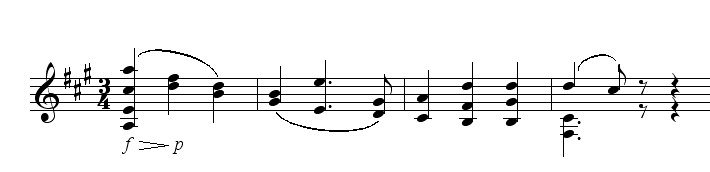
The last note (the resolution) is short; after the breadth and lyricism of the idea, it gives itself over abruptly to silence. I think this is one of those unusual, extraordinary beginnings that distinguishes itself from the greater mass of classical openings not through any outrageous harmonic maneuver, ambiguity, or daring, but through the audacity of its sudden, naked Appearance: the Idea itself, presented whole (immaculate conception). It does not ask the typical questions of "famous" openings, such as What Key Am I In? or Where's the Downbeat? or What's the Tempo? or so forth (all more or less rephrasings of the common life question Where Am I Going?); all those questions are dismissed as unimportant (the neurotic concerns of other pieces), as the initial Idea speaks, presents to us its "grain" (like that of a piece of wood). A lot of times listening to the beginnings of classical pieces, I can say to myself: yes, this opening idea comes from the tonic triad, and this is the coy reply moving us to the dominant, etc. etc ... in these cases the opening ideas, the premises, their questions and answers, derive from the familiar and common, and allow us to experience the music gradually, as an unfolding of "logic": drapery on the scaffolding of tonality. Not as a shock of identity. I have a hard time seeing where the opening of the Kreutzer "comes from." There are no easy sources for its particular beauty. The sort of question I feel it asks is Why Do I Exist? or How Did I Come Into Being? And that is what gives it, for me, a kind of surreal beauty: an oddly certain question, a fragment that is strangely and prematurely complete. The piece is mature beyond its measures.
[Regular readers of Think Denk are not deluding themselves if they imagine, or anticipate with sinking certainty and dread, that I am drawing some implicit comparison between the opening of the Kreutzer Sonata and a steaming plate of dumplings; BUT do they suspect I am willing to sink yet sillier and imagine the ensuing piano phrase as soy sauce? This may yet have been left to the imagination; too late, now. I am sorry.]
After a half bar of silence... a silence that might be interpreted "how do I respond to that?" ... the piano finds something to say: what appears to be the same idea, but from its second note shifting dramatically into the minor key.
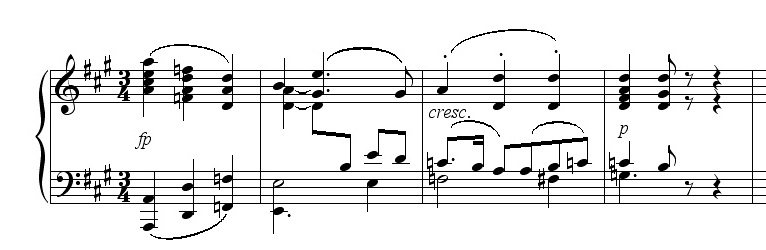
After the shock of this, one can come to an understanding: Beethoven is setting up a dualism of light/dark. The violin idea, unmarred by accidentals, seems to represent light, pure A major; whereas the pianist wanders into a darker place, the shadowy antithesis. But interestingly, the pianist's phrase, for all its dark F-naturals, concludes on a luminous G major chord (with a beautiful F-sharp suspension!)... it cannot decide whether to be night or day. I sense four separate moments of shock in the piano's opening statement: 1) the pianist's first note, the opening forte/piano, breaking the silence; 2) the pianist's second note (shifting unexpectedly to minor); 3) the downbeat of the pianist's third bar, with the deceptive bass motion up a half-step; and 4) the G major "arrival" (subito piano... a beauty, a sweetness, which was not anticipated). Such a density of surprise is hard to absorb; I realize, that for the "average" concertgoer, it may not even exist; but I think it is there. At one level, one perceives a very simple light/dark antithesis, but at another, events present a much more complicated question/answer in which the nature and identity of the essential dualism is in doubt.
From the outset, the piano is not an original thinker; it (he/she) is repeating, rethinking, reassessing... derivative, complex, living in a world already created by the hand of the violinist. (Pianist as original sin? curse of knowledge?) As events unfold, the violinist and pianist together undergo the darkest, most searing moment of the introduction--a moment which basically repeats the bass motion, and thus the essential "meaning" of the pianist's opening statement--
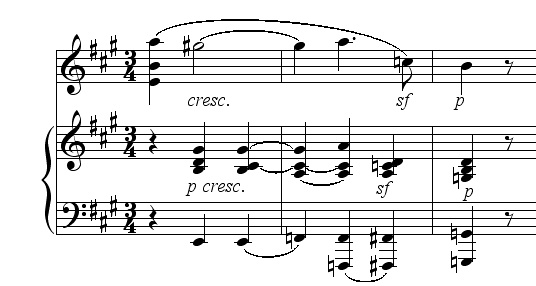
And they, too, together come to realize that fragile G major is the precarious answer. How can G major be an answer, in the key of A major? Through the obvious expedient of two rising fourths, A-D, D-G, (or two descending fifths) Beethoven arrives impossibly far afield. This, too, I think the "average" hypothetical median concertgoer (who does not really exist) does not always perceive. Sometimes, while I am playing the piece, and when we get to that moment, and someone coughs a bored cough right then, in the shocked, supreme, post-G-major silence, I want to get up from the piano and explain to them how incredibly amazing it is that Beethoven takes us there, how he tries to rock our world and propose that 2+2=3. It is like that scene in Ocean's Twelve where Clooney and co. want to rob a house in Amsterdam and the window is a foot too low for their scheme, and so they decide to dive underwater and raise the entire building up a foot using winches or something. That's how weird and wild it is to move from tonic A major to G major (flat seven!!!!!!); imagine the two root position chords next to each other, all the parallel fifths and octaves; all the rules and taboos that are broken to be there. I would deliver this little speech and people would be weeping for amazement, fainting for pleasure, and paralyzed by the marvel of Beethoven's audacity; one small sob would break out from the back of the house, and be reluctantly muffled; and then we would sit back down and play on. Haha.
For G major is the "wrong" answer to A major; it fits in no nacho/margarita category of the obvious. Its answeritude (answer+attitude=the quality of being an answer) comes from another source; it is more of a spiritual, metaphorical answer (light passing through dark to get to another, different light), which of course spins around on itself and becomes the question. I cannot help juxtaposing the strangeness of this answer against the circularity and precocious completeness of the violin's first statement; what kind of world is it where the opening idea can be so serene, beautiful and extraordinary, so insular and perfect; and then the harmonic basis can tectonically shift down a radical whole-step? A world where dumplings don't have to be eaten to be savored, where questions and answers are like free radicals, bonding with unexpected mates.
Towards the end of the first movement, after all our storm and stress, there is another wonderful, disturbing nexus of questions and answers. The violin proposes a cadence in B-flat major (impossible), in Adagio:
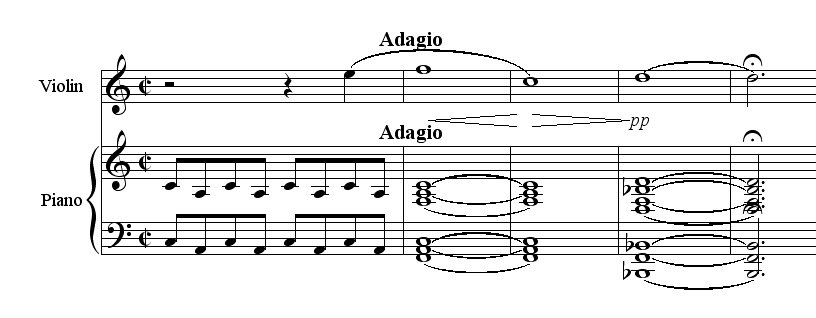
Every night at the piano I offer up a little prayer of thanks to my bassline of that moment, sinking that unthinkable fifth from F to B-flat. As always, V goes to I; the cliché spawns the revolution. A revolution because the "grain" of B-flat grates deeply against the prevailing A minor... literally and metaphorically. The moment is temporally distended; we are forced to sit and listen to the impossible. As in so many Beethoven angry minor-key movements, the metaphor of the island of calm is engaged; little patches, oases of lyricism, scattered throughout the movement (the second theme, for instance), call to each other structurally across stormy expanses ... and this is the crucial last one, farewell and summary, the violin's last halt to the movement's urge of relentless motion, so unutterably beautiful, expressing so much in the concision of its three chorale-like notes, distilling the idea again back to its essence... saying "stop, wait." To which the piano responds fatefully, without speeding up, twisting the harmony with the same three notes:
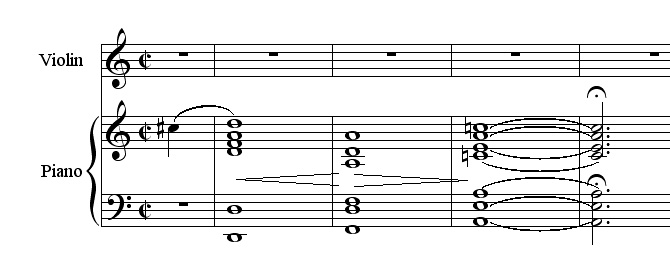
Although the rhythm is still stopped, though we are yet suspended in the standstill (marvelling, waiting), the harmonies have wended their way back to A minor, which means we know with that sinking feeling that we are back in the tragic world of the movement's overall gesture. The piano is again "too complicated," it answers with mixed messages; we are stopped, but wary; we know that an outburst is coming (we fear it)... there is a realization but it is fatal. I will never play to my satisfaction those last two Adagio chords; the connection between them has to express so much (falling, relinquishing, inevitability, despair).
And then the outburst happens ... the movement crashes to an end... The audience seems always to get caught up in this moment, to want to applaud; I too am thrilled and often feel demonically possessed by this ending, by our scales and ferocious concluding chords, dominant/tonic. But something about this last answer always seems misplaced. Its fury cannot possibly "answer" or resolve the pathos of those two preceding Adagios; there is no balancing, no summing up, what has occurred: there is too much. It is like a person in denial, a person who still thinks one question has one answer, and rages impotently against multivalence. Wow, how did I get there from dumplings? Perhaps via Beethoven.