"Certain people, whose minds are prone to mystery, like to believe
that objects retain something of the eyes which have looked at them,
that old buildings and pictures appear to us not as they originally
were but beneath a perceptible veil woven for them over the centuries
by the love and contemplation of millions of admirers. This fantasy,
if you transpose it into the domain of what is for each one of us the
sole reality, the domain of his own sensibility, becomes the truth.
In that sense and in that sense alone (but it is a far more important
one than the other), a thing which we have looked at in the past
brings back to us, if we see it again, not only the eyes with which we
looked at it but all the images with which at the time those eyes were
filled. For things--and among them a book in a red binding--as soon
as we have perceived them are transformed within us into something
immaterial, something of the same nature as all our preoccupations and sensations of that particular time, with which, indissolubly, they blend. A name read long ago in a book contains within its syllables
the strong wind and brilliant sunshine that prevailed while we were
reading it. And this is why the kind of literature which contents
itself with "describing things," with giving of them merely a
miserable abstract of lines and surfaces, is in fact, though it calls
itself realist, the furthest removed from reality and has more than
any other the effect of saddening and impoverishing us, since it
abruptly severs all communication of our present self both with the
past, the essence of which is preserved in things, and with the
future, in which things incite us to enjoy the essence of the past a
second time. Yet it is precisely this essence that an art worthy of
the name must seek to express; then at least, if it fails, there is a
lesson to be drawn from its impotence (whereas from the successes of
realism there is nothing to be learnt), the lesson that this essence
is, in part, subjective and incommunicable."
... Marcel Proust
Thursday, April 13, 2006

Monday, April 10, 2006
I, Odysseus
"Heidi," I grunted into my cell phone, "do you have what I need?" The breeze was stiff and my mind was scattered. At some point in every day, I realized, I reach a mini-crisis contemplating whether someone will, in the long- or short- term, have something I need.
In this case, classical musicians will know to whom I refer: the indomitable guardianess of Frank Music, on 54th Street. She and I have had a mostly mock antagonism for years, since I first glanced askance at her prices. I remember well the subsequent punishment she doled. They say a butterfly in China can cause a hurricane in Florida; and similarly my slightly raised eyebrow (at a Barenreiter price), perhaps the motion of a half centimeter, precipitated a tremendous verbal, virtual storm: off she went about her pitiable situation, and how she didn't get into this business for money but all she hears about is money money money... and never before or since have I felt like such a miserable, soulless mercenary trampling on music's sacred grove. I begged her forgiveness, of course. She has a magnificent ability to evoke the miseries of her business at a moment's notice, threading, like the great composers, masterful variation on top of limited themes; you feel guilty for even noticing the prices she is charging, for imagining that music could ever be expensive. This is just one of the qualities that makes Heidi a paragon of the True New Yorker, and, along with necessity, keeps me haunting her unadorned abode. The shop also smells wonderfully, like Old Library, like the Performing Arts Library when it used to be temporarily in the wilds of way west 43rd street, in an old school building: like must and mold and books and--dare I say it?--it even smells like having a ruler rapped on your knuckles, like a life lived in fear of headmasters and nuns. Somehow I find this smell and its associations weirdly focusing, even addictive; perhaps subconsciously I get some rush of pleasure from the idea of being forced to study ... there is some element of lovable punishment in visiting Frank Music.
Upon returning from my visit (which Homeric incident could Frank be compared to--the island of the sacred cows? the lotus-eaters? Hades? Circe? The cyclops?) I found myself oddly drawn into another adventure. Usually ascending the stairs from the 96th St. station is a glum, treading affair--with the tiredness of commuters like a prolonged, silent, surrounding sigh--proceeding more or less in a linear, uneventful fashion. I trod. There was a tremendous violence, suddenly. All around me, suitcases were falling down steps, collapsing onto people; girls were squealing and cussing; I heard a flurry of "ganz schlecht" and "scheisse" and other phrases which I'm sure were less reputable, and I realized I was caught in a maelstrom of visiting, beautiful German students, and it seemed strange to me that all this youth and freshness was able to be significantly bummed out, even stymied, by a flight of stairs. They clustered and regrouped like foreign bees unsure of their hive. It was impossible to walk around them; I was caught in their midst, fearing a suitcase at any moment, crashing from steps above; I was in mortal peril from these clueless youth. There was a TOTAL STOPPAGE; I imagined impatient Real New Yorkers from behind, building up pressure as water behind a dam, and hoped I would not be drowned in some melee. The noise and confusion was terrifying; then, somehow, I broke through; I passed the turnstile, homefree, and jogged by the leader of the pack, the Mother Superior of the young Germans, looking up unhappily, assessing the next and final flight. Would her birds survive? The Germans ate my sneakered dust. Whew, I thought, as I passed the shoal of Starbucks, I must head home and lick my psychic wounds. What suitors will I find there, disrupting my happiness?
A giant pile of unlearned music. A sink full of dishes. A table full of mail.
The suitors all need my attention; I cannot slay them without another Odyssey, more perilous than the last. And the object of their wooing, their Penelope, is my attention, which I must give over to them, willingly; I have to pay their many and varied debts.
In this case, classical musicians will know to whom I refer: the indomitable guardianess of Frank Music, on 54th Street. She and I have had a mostly mock antagonism for years, since I first glanced askance at her prices. I remember well the subsequent punishment she doled. They say a butterfly in China can cause a hurricane in Florida; and similarly my slightly raised eyebrow (at a Barenreiter price), perhaps the motion of a half centimeter, precipitated a tremendous verbal, virtual storm: off she went about her pitiable situation, and how she didn't get into this business for money but all she hears about is money money money... and never before or since have I felt like such a miserable, soulless mercenary trampling on music's sacred grove. I begged her forgiveness, of course. She has a magnificent ability to evoke the miseries of her business at a moment's notice, threading, like the great composers, masterful variation on top of limited themes; you feel guilty for even noticing the prices she is charging, for imagining that music could ever be expensive. This is just one of the qualities that makes Heidi a paragon of the True New Yorker, and, along with necessity, keeps me haunting her unadorned abode. The shop also smells wonderfully, like Old Library, like the Performing Arts Library when it used to be temporarily in the wilds of way west 43rd street, in an old school building: like must and mold and books and--dare I say it?--it even smells like having a ruler rapped on your knuckles, like a life lived in fear of headmasters and nuns. Somehow I find this smell and its associations weirdly focusing, even addictive; perhaps subconsciously I get some rush of pleasure from the idea of being forced to study ... there is some element of lovable punishment in visiting Frank Music.
Upon returning from my visit (which Homeric incident could Frank be compared to--the island of the sacred cows? the lotus-eaters? Hades? Circe? The cyclops?) I found myself oddly drawn into another adventure. Usually ascending the stairs from the 96th St. station is a glum, treading affair--with the tiredness of commuters like a prolonged, silent, surrounding sigh--proceeding more or less in a linear, uneventful fashion. I trod. There was a tremendous violence, suddenly. All around me, suitcases were falling down steps, collapsing onto people; girls were squealing and cussing; I heard a flurry of "ganz schlecht" and "scheisse" and other phrases which I'm sure were less reputable, and I realized I was caught in a maelstrom of visiting, beautiful German students, and it seemed strange to me that all this youth and freshness was able to be significantly bummed out, even stymied, by a flight of stairs. They clustered and regrouped like foreign bees unsure of their hive. It was impossible to walk around them; I was caught in their midst, fearing a suitcase at any moment, crashing from steps above; I was in mortal peril from these clueless youth. There was a TOTAL STOPPAGE; I imagined impatient Real New Yorkers from behind, building up pressure as water behind a dam, and hoped I would not be drowned in some melee. The noise and confusion was terrifying; then, somehow, I broke through; I passed the turnstile, homefree, and jogged by the leader of the pack, the Mother Superior of the young Germans, looking up unhappily, assessing the next and final flight. Would her birds survive? The Germans ate my sneakered dust. Whew, I thought, as I passed the shoal of Starbucks, I must head home and lick my psychic wounds. What suitors will I find there, disrupting my happiness?
A giant pile of unlearned music. A sink full of dishes. A table full of mail.
The suitors all need my attention; I cannot slay them without another Odyssey, more perilous than the last. And the object of their wooing, their Penelope, is my attention, which I must give over to them, willingly; I have to pay their many and varied debts.
Tuesday, April 4, 2006
Brahms the Sicilian
Unless I am running for my train, I find it difficult or impossible to pass through Penn Station without getting a Red Sicilian slice at Rosa's Pizza. It appears to be an unruly sea of roiling tomato sauce barely adhering to a thick chunk of bread, but some cheesy, salty secret lies hidden, baked in the redness. How did the tomato find such luxuriant and wonderful friends, and why are they all in my mouth at the same time? Such touching questions are dismissed in favor of rabid munching.
I would like to think some similar, ineluctable urge caused Schoenberg to abandon tonality. Today we say "it was atonal" glibly: ho-hum. But imagine the excitement of those composers, writing atonally for the first time, as they "felt the air of other planets." After all that overwhelming beautiful history, the recorded human history of writing centered around a tone or tones... to step off and deliberately write music with no pitch center at all! No wonder they got kind of Messianic; it must have been thrilling. Just like the moment, after pouring off half of the grease, when I lift the lumbering red slice to my slavering mouth. Yes, the doctor will frown after your next cholesterol test, and yes you may be condemned now to writing some of the least loved music ever heard, but what of it? According to that crazy cat Anton Webern:
If Anton hadn't passed away some time ago, I would seriously have recommended some therapy. Need I enumerate my reasons? 1) Schoenberg (as father figure) giving the law. 2) The law as salvation; am I the only one smelling Kafka here? ("The door was meant only for you, and now I am going to shut it.") 3) The law "forced itself upon them": the law as rapist, as seducer? To be oddly and immediately followed by 4) The law as bride, as lifelong romantic committment? Umm, perhaps I prefer the law of Law & Order. But finally, the voice of reason: "Trust your inspiration! There is no alternative." This, at least, I can agree with.
If indeed the idea of composing without a dominating single tone was a unbelievable thrill, comparable to the arrival of the 40-cent Triple Chocolate Brownie cookie at my local Starbucks (which I now order in satisfying, cute clumps of 4), I had managed to take it for granted, or subjugate it as merely a relic of Music History Survey Class--with all its associations of furtive caresses in library carrels and listening booths--and today, perhaps in karmic retribution for this neglect, I felt completely incapable of convincing a group of Bard students of this thrill, which I glimpsed ... But perhaps I was more disquieted at being unable to communicate the power of the fragments of nineteenth-century tonality they left behind... For example, in Schoenberg's Op. 19, #6, this one climactic phrase:
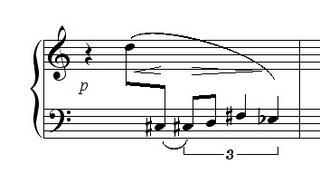
I have to feel sorry for these beautiful, yearning, enigmatic notes, crafted so that you cannot decide between them, and adding atop this ambiguity the rhythmic befuddlement of quarter note triplets, beginning with a tie and resolving into thin air. A "hairpin," headed for a central intense point, fading away, and to what end? A romantic gesture stripped naked, purged of its underlying signifying harmonies, and trying to mean so very much in their absence: being forced to do so: trying to assume the burden of all that meaning. All right little notes, we've coddled you too long, you're on your own now!
Parenthetically, I'm not sure how I feel about sentences with two colons in them.
A similar sense of crisis, I think, but from just the other side of the divide, haunts Brahms Op. 119 #1 (a place which makes you "feel sorry" for Brahms?)... a piece with strikingly beautiful opening bars, in which thirds spread out like tentacles from a single note, connoting triads freely, kaleidoscopically. Each bar is a fragment, listening to the consequences of these roving thirds, offering no resolution, looking for some more definitive continuation. (A letter of Brahms indicates how he wished these bars to be performed--indications which are often ignored, oddly.) These harmonies--9th and 11th chords etc.--are so familiar to us now from jazz and the whole mishmosh of 20th-century "extended" musical language, that perhaps we have an unfortunate tendency to hear them as "pretty sounds." However, I think their power resides in a double meaning, in the play of meanings, a kind of irony: the uneasy coincidence of a discovered sensual beauty with a sense that somehow this is "not right," a betrayal of principles, of the very things that made his music possible in the first place. Brahms suspects his inner sensualist. This beauty is treacherous. This irony is compounded: Brahms' life's work is filled with powerful use of thirds (perhaps more characteristically than any other interval)--as building block of melody and as prime mover in bass; and now this easy movement by thirds erodes the edifice, threatens to take down the tonal structure: Brahms' own style, subjected to introspection and magnification, threatens to destroy itself.
But, as Anton says: "trust your inspiration! there is no alternative." Brahms is forcing himself into this place, confronting the limits of his own language... accepting the collapse of any language.
I would like to think some similar, ineluctable urge caused Schoenberg to abandon tonality. Today we say "it was atonal" glibly: ho-hum. But imagine the excitement of those composers, writing atonally for the first time, as they "felt the air of other planets." After all that overwhelming beautiful history, the recorded human history of writing centered around a tone or tones... to step off and deliberately write music with no pitch center at all! No wonder they got kind of Messianic; it must have been thrilling. Just like the moment, after pouring off half of the grease, when I lift the lumbering red slice to my slavering mouth. Yes, the doctor will frown after your next cholesterol test, and yes you may be condemned now to writing some of the least loved music ever heard, but what of it? According to that crazy cat Anton Webern:
Only when Schoenberg gave expression to the law were larger forms again possible. Adherence to the row is strict, often burdensome--but it is salvation! The dissolution of tonality wasn't our fault--and we did not create the new law ourselves; it forced itself overwhelmingly upon us. The commitment is so powerful that one must consider very carefully before finally entering into it... almost as if one took the decision to marry; a difficult moment! Trust your inspiration! There is no alternative.
If Anton hadn't passed away some time ago, I would seriously have recommended some therapy. Need I enumerate my reasons? 1) Schoenberg (as father figure) giving the law. 2) The law as salvation; am I the only one smelling Kafka here? ("The door was meant only for you, and now I am going to shut it.") 3) The law "forced itself upon them": the law as rapist, as seducer? To be oddly and immediately followed by 4) The law as bride, as lifelong romantic committment? Umm, perhaps I prefer the law of Law & Order. But finally, the voice of reason: "Trust your inspiration! There is no alternative." This, at least, I can agree with.
If indeed the idea of composing without a dominating single tone was a unbelievable thrill, comparable to the arrival of the 40-cent Triple Chocolate Brownie cookie at my local Starbucks (which I now order in satisfying, cute clumps of 4), I had managed to take it for granted, or subjugate it as merely a relic of Music History Survey Class--with all its associations of furtive caresses in library carrels and listening booths--and today, perhaps in karmic retribution for this neglect, I felt completely incapable of convincing a group of Bard students of this thrill, which I glimpsed ... But perhaps I was more disquieted at being unable to communicate the power of the fragments of nineteenth-century tonality they left behind... For example, in Schoenberg's Op. 19, #6, this one climactic phrase:

I have to feel sorry for these beautiful, yearning, enigmatic notes, crafted so that you cannot decide between them, and adding atop this ambiguity the rhythmic befuddlement of quarter note triplets, beginning with a tie and resolving into thin air. A "hairpin," headed for a central intense point, fading away, and to what end? A romantic gesture stripped naked, purged of its underlying signifying harmonies, and trying to mean so very much in their absence: being forced to do so: trying to assume the burden of all that meaning. All right little notes, we've coddled you too long, you're on your own now!
Parenthetically, I'm not sure how I feel about sentences with two colons in them.
A similar sense of crisis, I think, but from just the other side of the divide, haunts Brahms Op. 119 #1 (a place which makes you "feel sorry" for Brahms?)... a piece with strikingly beautiful opening bars, in which thirds spread out like tentacles from a single note, connoting triads freely, kaleidoscopically. Each bar is a fragment, listening to the consequences of these roving thirds, offering no resolution, looking for some more definitive continuation. (A letter of Brahms indicates how he wished these bars to be performed--indications which are often ignored, oddly.) These harmonies--9th and 11th chords etc.--are so familiar to us now from jazz and the whole mishmosh of 20th-century "extended" musical language, that perhaps we have an unfortunate tendency to hear them as "pretty sounds." However, I think their power resides in a double meaning, in the play of meanings, a kind of irony: the uneasy coincidence of a discovered sensual beauty with a sense that somehow this is "not right," a betrayal of principles, of the very things that made his music possible in the first place. Brahms suspects his inner sensualist. This beauty is treacherous. This irony is compounded: Brahms' life's work is filled with powerful use of thirds (perhaps more characteristically than any other interval)--as building block of melody and as prime mover in bass; and now this easy movement by thirds erodes the edifice, threatens to take down the tonal structure: Brahms' own style, subjected to introspection and magnification, threatens to destroy itself.
But, as Anton says: "trust your inspiration! there is no alternative." Brahms is forcing himself into this place, confronting the limits of his own language... accepting the collapse of any language.
Subscribe to:
Posts (Atom)