At Saigon Grill two black-haired, scruffy male singers are arguing over a melody, singing it to each other in solfège. I admit, I find this reprehensible. As I settle in for yet another Vietnamese luncheon, I wish to be sonically neutral, awaiting my steaming gleaming heaping plate; solfège gives me preemptive indigestion. “It is a joy,” one explains unctuously to the other, “it is nice.” Instantly I want to smash and pulverize their joys so they would sit, at least, in shocked silence, which would be--what is the right word?--preferable.
They continue conversing semi-musically; I lose the thread. But then the more vocal one pipes up his instrument and says: “I was like” -- cluck -- “honey,” initiating the cadence so familiar to New Yorkers, the beautiful scraping rhythm and refrain of someone finally informing an irritating other exactly how clueless they are, “that’s the problem... you have NO technique.” His hands move quickly outward in a paradoxical demonstration of nonexistence.
Ah, I have travelled so far.
I climbed over and between black, brown and gray rocks, negotiating a route which just seemed too detailed. Patience-testing. Each rock, I thought, is a different shape. Very few were obligingly flat-topped, and some were slippery with seaweed, and the long beach was there in the distance like advertised paradise, awaiting my trip through rocky limbo. I crawled, stepped, braced, squeezed; time passed. Finally the rocks began to thin, and I found a sandy strip and pulled off my brown shoes and set them on the gray wet sand and also my white socks which looked so strangely luminous-white, and set them in a safe zone away from changing tides, and went out to the crescent of soft sand with the beautiful shallow approaching waves, waves an inch deep at most which crept up the sand like long water fingers.
Alone--on a huge isolated beach with water coming up which would eventually touch the crumbling cliffs at my back. Ah, I thought, addressing the ocean in my mind, now we can really get down to business. Now we must have that heart-to-heart we’ve been postponing for so long, great Mother Ocean, and I prepared almost to fight it like a child taking on a bully. Kick it, splash it, give it what fer. Give vent to my joy. But the most extraordinary element, really, was that it was so apparent there was nothing to fight. Or I guess: it was amazing how this became apparent. There was a rhythm to this revelation. Some vector of intention which I had brought with me eagerly to the beach, some totally undeclared purpose, melted as my feet numbed happily in the cold shallow water. I swear the ocean seemed to answer with a giant radiating slow silent word. No question was asked. The word, I repeat, was not the sounding waves; it had perhaps just as much to do with the slatish sky or the green gorse which hovered around on the perilous cliffs looking down to see what I, or it, might do. It was not spoken, it was situational, it was like air. Patient ocean, so different from I, hurried rock-clamberer. I searched my state of self; I did not feel affected, prideful, stupid, foolish, pressed, hopeful, hungry, insightful, wishful, accomplished, thoughtful, selfless, fretful, calm, centered, or scattered; adjectives fell off me like water off rock, innumerable.
If one thing could really be said about my situation is that I wanted to take greater advantage of it, to be worthier of it, to do justice to the word “experience.” And it was not following the conventional script, starting with “such a beautiful spot” and ending with a snapshot for one’s desktop picture... Yes it was incredibly beautiful and I felt enclosed, cuddled, sensually alive ... But most importantly some sense of presence occurred which reversed the conventional structure of action, not “I saw a beautiful place” but “A beautiful place spoke me.” Not spoke “to” me, for fuck’s sake; spoke me myself and myself only without prepositions, as if a man opened his mouth and out came a picture. My desire--more, more, experience this more--was only a kind of impatient vibrating at my own boundaries. If only I could be this way in the presence of other people, those dear to me, if only I would let them speak me, then I might speak them too; and it was very clear from the sea’s silent crashing that I was the only obstacle. Ocean was not approving or disapproving, just observing and for once I didn’t resent its personal advice. I was the only living rock on the beach, brightly clad, rolled-up jeans rock, pacing back and forth in the sunset, the only rock which was not married to the ground and sand and against which the sea might break itself merrily, if only I would let go of something more.
An hour or so later, I stared out the window of the main house at the Last Sunset, which daubed just the tip of the black promontory yellow-green, and listened to the crashing waves, now pane-muffled. Two banks of clouds sitting awkwardly in the sky were lit too at their tops with surreal sunlight and when I blinked, and looked again, a half moon had appeared between them, and it seemed like there were just too many beautiful events all at once and you just had to keep looking until some inner switch clicked off and you knew. Then: a melancholy dark dinner with candles and goodbyes; a short swift night drive down country lanes hurling headlamps against the endless curling green hedges; and white bunnies, lit up whiter-than-white, fleeing the oncoming car like scattered ghosts; and a long, clattering machine carrying me, us, back to civilization and do, re, mi.
Tuesday, October 3, 2006

7:37 AM, Paddington Station
A certain cellist who shall remain nameless (but whose initials are those of a very popular magazine with a recurring swimsuit issue) seems to think Clara Schumann may have not been a very nice person. I cannot supply a transcript of the late night discussion here, for reasons of decency. The Great Clara Debate, pro or con, rages on, as if we are somehow angry with Music History for allowing two of our Favorite Guys to fall in love with the same Controlling Woman.
However, I was shifting somewhat Pro-Clara (doesn’t that sound like a shampoo?), while playing her husband’s piano quartet.
Clause one of the universal indictment: she applied pressure to her husband, encouraging him to write in classical forms (sonata etc.) when his genius was suited to a more radical reinvention of form: to shorter pieces linked in chains, or some other solution which he might have found if only Clara hadn’t been such a stickler. This indictment is irrefutably founded on hypotheticals. I too am impossibly seduced by what Schumann might have written. Yes, we have Davidsbündlertänze, we have Carnaval, and the strange sonata amalgam of the Fantasy ... but don’t you sometimes catch yourself imagining some even more revolutionary work, in which Schumann’s tremendous imagination dissolves the whole Narrative Ethos of Western Music into heartrending fragments, in which one no longer longs for, no longer requires coherence? Something which would have ended the whole infantile fetishization of Sonata Form, which at times debilitated even the greatest Romantics? I do.
Rufus Wainwright has something to say about Schumann; he just came on the Starbucks soundtrack here in Paddington ... but I can’t quite translate the message ...
But let’s consider another tantalizing hypothetical: without Clara’s pushing Robert might never have pondered in depth the delicate “fantasization” of the Classical harmonic world. Sitting in Prussia Cove, I find myself close to the place in my brain I inhabit when I am in love (substituting music as so often for elusive reality), listening to the unfolding opening of the Piano Quartet. The strings play E-flats, and the piano plays an ascending sixth:
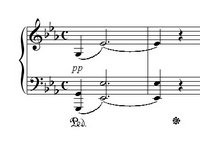
This resounding sixth, made blurry totality by the held pedal ... a fantastic otherworldly sound, predicated on the simplest proposition: the first note, the bass, is not the root of the chord, but its third. Why couldn’t other composers think of that bar? Something Brahms only rarely (if ever) learned to do: make the first bar an “extra” bar, an unnecessary item, a non-event depending on how you count events -- a bar for listening, not telling (Beethoven slow movement of Hammerklavier opening). A bar in which semantic space is opened, not defined.
The pedal and the ascent from the deep bass--the bass which refuses to go away just yet, at least not until we have truly heard it--is a Romantic symbol, connoting space, aura: as if E-flat major (that most classical, refined, elevated of keys) were echoed off something greater, were the mere worldly reverberation of a more profound spiritual force. (Pedal: echo, overtone, undampened string, vibration.) E-flat has arrived from somewhere; the piano suggests somehow the existence of this other place without being able, in music, to show it. Incredibly, the phrase that the strings play in response to this enigma could easily be an opening by Mozart/Beethoven/Haydn--simple, textbook, linear, architectural, tonic-to-dominant.
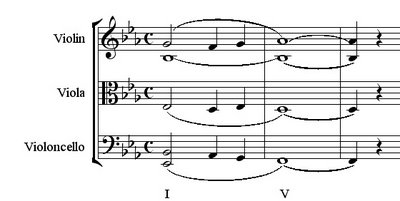
The Classical Phrase is thus “born” out of the sound of E-flat major, out of the pedalled ambiguity. Classical clarity has been reframed, resituated--in the context, perhaps, of pure sound. (Schumann’s opening bar implores us to hear sound as sound, not as discourse.)
The opening, “listening,” bar is Romantic enigma, and the next two bars are pure Classicism; the slow introduction is a gentle (but absolutely riveting) dialogue between these tendencies: not a competition between them but an interlacing, in which fantasy and phrase (yearning and definition) use each other as points of reference, to supply each other’s lack.
So, too, the opening of the ensuing Allegro non troppo. Schumann launches us with what could be a classical antecedent:
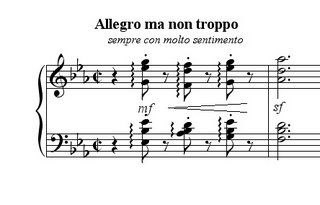
but then composes a strange, spinning, asymmetrical consequent:
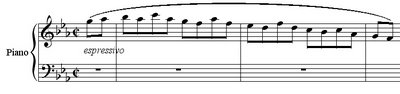
There is no way to know when the piano will finish; the chain of notes is endless, undelineating and undelineated, as if the pianist is simply lost in the idea, in the joyful setting-forth. So: in place of the answered question, we get a wandering curlicue. Schumann adores placing the ungrammatical in the grammatical niche, sticking an adjective where the verb must be. In this case, no resolution of the dominant seventh ... simply an elaboration of it, a giant Romantic ornament.
Somehow, Schumann’s cross-pollination of Classic and Romantic maintains a Mozartean transparency, a charm and elegance. The junctures are strange but not jolting. In the Piano Quartet he provides Romanticism without decadence or decay, in joyful, prideless, humorous possession of aesthetic discoveries, not collapsed into struggle or conflict or any kind of despair or confusion. In other words: a high water point, a magical moment in Music History. Where would all this be without Clara? Unanswerable question. Schumann’s encounter (in this case) with classical form produces an unbelievable and delicate fusion, a kind of perfection in which the gushing Romantic is not at all tiresome in his teenage accesses of passion and does not wear himself out yearning but makes his passionate singing useful to the adult world. He refutes Rilke’s annoying, pretentious Zen-ishness:
He (Robert Schumann) says: Rainer, I prefer not to forget that passionate music. I am a young man loving, and I will woo, and achieve grace. Which is why I (Jeremy Denk) will--for the moment--defend Clara from the besmirching hand, and live for a few more days with Schumann’s magical-classical E-flat major (like magical realism), and not so much with Rilke’s melancholy, oh-so-enlightened, resigned “reality.” Schumann's passionate music does not seem yet to have found its end, so there.
However, I was shifting somewhat Pro-Clara (doesn’t that sound like a shampoo?), while playing her husband’s piano quartet.
Clause one of the universal indictment: she applied pressure to her husband, encouraging him to write in classical forms (sonata etc.) when his genius was suited to a more radical reinvention of form: to shorter pieces linked in chains, or some other solution which he might have found if only Clara hadn’t been such a stickler. This indictment is irrefutably founded on hypotheticals. I too am impossibly seduced by what Schumann might have written. Yes, we have Davidsbündlertänze, we have Carnaval, and the strange sonata amalgam of the Fantasy ... but don’t you sometimes catch yourself imagining some even more revolutionary work, in which Schumann’s tremendous imagination dissolves the whole Narrative Ethos of Western Music into heartrending fragments, in which one no longer longs for, no longer requires coherence? Something which would have ended the whole infantile fetishization of Sonata Form, which at times debilitated even the greatest Romantics? I do.
Rufus Wainwright has something to say about Schumann; he just came on the Starbucks soundtrack here in Paddington ... but I can’t quite translate the message ...
But let’s consider another tantalizing hypothetical: without Clara’s pushing Robert might never have pondered in depth the delicate “fantasization” of the Classical harmonic world. Sitting in Prussia Cove, I find myself close to the place in my brain I inhabit when I am in love (substituting music as so often for elusive reality), listening to the unfolding opening of the Piano Quartet. The strings play E-flats, and the piano plays an ascending sixth:
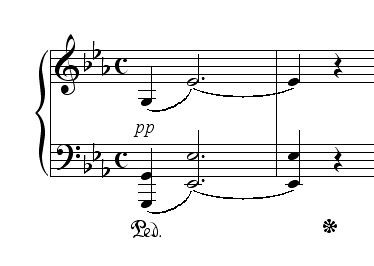
This resounding sixth, made blurry totality by the held pedal ... a fantastic otherworldly sound, predicated on the simplest proposition: the first note, the bass, is not the root of the chord, but its third. Why couldn’t other composers think of that bar? Something Brahms only rarely (if ever) learned to do: make the first bar an “extra” bar, an unnecessary item, a non-event depending on how you count events -- a bar for listening, not telling (Beethoven slow movement of Hammerklavier opening). A bar in which semantic space is opened, not defined.
The pedal and the ascent from the deep bass--the bass which refuses to go away just yet, at least not until we have truly heard it--is a Romantic symbol, connoting space, aura: as if E-flat major (that most classical, refined, elevated of keys) were echoed off something greater, were the mere worldly reverberation of a more profound spiritual force. (Pedal: echo, overtone, undampened string, vibration.) E-flat has arrived from somewhere; the piano suggests somehow the existence of this other place without being able, in music, to show it. Incredibly, the phrase that the strings play in response to this enigma could easily be an opening by Mozart/Beethoven/Haydn--simple, textbook, linear, architectural, tonic-to-dominant.
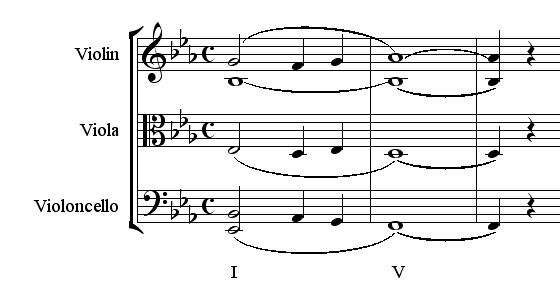
The Classical Phrase is thus “born” out of the sound of E-flat major, out of the pedalled ambiguity. Classical clarity has been reframed, resituated--in the context, perhaps, of pure sound. (Schumann’s opening bar implores us to hear sound as sound, not as discourse.)
The opening, “listening,” bar is Romantic enigma, and the next two bars are pure Classicism; the slow introduction is a gentle (but absolutely riveting) dialogue between these tendencies: not a competition between them but an interlacing, in which fantasy and phrase (yearning and definition) use each other as points of reference, to supply each other’s lack.
So, too, the opening of the ensuing Allegro non troppo. Schumann launches us with what could be a classical antecedent:

but then composes a strange, spinning, asymmetrical consequent:

There is no way to know when the piano will finish; the chain of notes is endless, undelineating and undelineated, as if the pianist is simply lost in the idea, in the joyful setting-forth. So: in place of the answered question, we get a wandering curlicue. Schumann adores placing the ungrammatical in the grammatical niche, sticking an adjective where the verb must be. In this case, no resolution of the dominant seventh ... simply an elaboration of it, a giant Romantic ornament.
Somehow, Schumann’s cross-pollination of Classic and Romantic maintains a Mozartean transparency, a charm and elegance. The junctures are strange but not jolting. In the Piano Quartet he provides Romanticism without decadence or decay, in joyful, prideless, humorous possession of aesthetic discoveries, not collapsed into struggle or conflict or any kind of despair or confusion. In other words: a high water point, a magical moment in Music History. Where would all this be without Clara? Unanswerable question. Schumann’s encounter (in this case) with classical form produces an unbelievable and delicate fusion, a kind of perfection in which the gushing Romantic is not at all tiresome in his teenage accesses of passion and does not wear himself out yearning but makes his passionate singing useful to the adult world. He refutes Rilke’s annoying, pretentious Zen-ishness:
Song, as you have taught it, is not desire,
not wooing any grace that can be achieved;
song is reality...
Young man,
it is not your loving, even if your mouth
was forced wide open by your own voice--learn
to forget that passionate music. It will end.
He (Robert Schumann) says: Rainer, I prefer not to forget that passionate music. I am a young man loving, and I will woo, and achieve grace. Which is why I (Jeremy Denk) will--for the moment--defend Clara from the besmirching hand, and live for a few more days with Schumann’s magical-classical E-flat major (like magical realism), and not so much with Rilke’s melancholy, oh-so-enlightened, resigned “reality.” Schumann's passionate music does not seem yet to have found its end, so there.
Monday, October 2, 2006
La Crónica de la Jornada
ESPAÑA: Llegaba la 5ª jornada en España, con esclarecedores resultados. El Barcelona, aunque lo pasó mal hasta la expulsión de uno de los leones, ganó al Athletic, con la baja de Eto'o. El Barcelona, por ahora, no está jugando como el año pasado, pero el bloque se ha hecho más fuerte y "resultadista" si cabe.
Pero afortunadamente, y tras lo visto esta jornada la Liga puede estar animada. El Sevilla y sobretodo el Valencia (con un Villa impresionante), confirmaron sus aspiraciones este año a grandes cosas.
Mientras en el R. Madrid, las aguas siguen revueltas. El Atlético, demostró en el Bernabeú dos cosas. Una que el Madrid no está bien, y otra que puede que éste sea por fin el proyecto definitivo del cuadro del Manzanares.
Esto por arriba, por donde también asoman a estas alturas el "Baby Depor" y un sorprendente Recreativo de Huelva.
Por abajo Racing, y los 2 vascos (Athletic y Real Sociedad), empiezan a ver de reojo el pozo del descenso, y los primeros rumores de destitucíon de entrenador empiezan a tomar forma.
INGLATERRA: Con el empate del líder (Chelsea), el Manchester ígualó en la clasificación al equipo de Mourinho tras vencer al Newcastle con 2 goles de Sjolskaer. El Arsenal también ganó, endulzando en algo unas últimas semanas desastrosas para los "gunners". El Liverpool, por contra, perdió ante el Bolton, siendo éstos últimos los 3º en la Premier.
ITALIA: El Milán frenó su ascensión en el Calcio, con un empate ante el Ascoli. El líder, el Palermo, perdió en Empoli, permitiendo a la Roma, alcanzar el coliderato. Ojo al Parma, que con 1 punto en 5 partidos empieza a ser un serio "favorito" al descenso.
ALEMANIA: La Bundesliga está loca y muy apasionante. Tras 6 jornadas hay 5 equipos empatados en el liderato con 10 puntos: Hertha, Nuremberg, Werder, Bayer Munich y Schalke 04.
FRANCIA: El Olympique de Lyon lleva camino de conseguir su sexta liga consecutiva. Esta vez venció a domicilio al Sochaux por 0-1. El único equipo que parece puede complicarle las cosas es el Oympique de Marsella, que vencía en casa al Toulouse por 3-0.
Pero afortunadamente, y tras lo visto esta jornada la Liga puede estar animada. El Sevilla y sobretodo el Valencia (con un Villa impresionante), confirmaron sus aspiraciones este año a grandes cosas.
Mientras en el R. Madrid, las aguas siguen revueltas. El Atlético, demostró en el Bernabeú dos cosas. Una que el Madrid no está bien, y otra que puede que éste sea por fin el proyecto definitivo del cuadro del Manzanares.
Esto por arriba, por donde también asoman a estas alturas el "Baby Depor" y un sorprendente Recreativo de Huelva.
Por abajo Racing, y los 2 vascos (Athletic y Real Sociedad), empiezan a ver de reojo el pozo del descenso, y los primeros rumores de destitucíon de entrenador empiezan a tomar forma.
INGLATERRA: Con el empate del líder (Chelsea), el Manchester ígualó en la clasificación al equipo de Mourinho tras vencer al Newcastle con 2 goles de Sjolskaer. El Arsenal también ganó, endulzando en algo unas últimas semanas desastrosas para los "gunners". El Liverpool, por contra, perdió ante el Bolton, siendo éstos últimos los 3º en la Premier.
ITALIA: El Milán frenó su ascensión en el Calcio, con un empate ante el Ascoli. El líder, el Palermo, perdió en Empoli, permitiendo a la Roma, alcanzar el coliderato. Ojo al Parma, que con 1 punto en 5 partidos empieza a ser un serio "favorito" al descenso.
ALEMANIA: La Bundesliga está loca y muy apasionante. Tras 6 jornadas hay 5 equipos empatados en el liderato con 10 puntos: Hertha, Nuremberg, Werder, Bayer Munich y Schalke 04.
FRANCIA: El Olympique de Lyon lleva camino de conseguir su sexta liga consecutiva. Esta vez venció a domicilio al Sochaux por 0-1. El único equipo que parece puede complicarle las cosas es el Oympique de Marsella, que vencía en casa al Toulouse por 3-0.
Subscribe to:
Posts (Atom)